
There's much more to a natural diamond than meets the eye. This article clearly and simply illustrates one of the most complex of the 4 Cs: diamond clarity.
We all have preferences when it comes to diamonds, such as which shape we like best. However, when it comes to buying a diamond, you shouldn't simply focus on the one you find most attractive.
Choosing the right one means going beyond what you see with the naked eye and truly understanding the diamond, its characteristics, and how these influence its beauty and value.
You've probably heard of the 4Cs of diamonds, and maybe you already know them: diamond cut, color, carat, and clarity.
These four characteristics constitute the essence of a diamond and, therefore, the grading system that determines the market price of a natural diamond.
Today we try to clearly illustrate one of the most complex and often most underestimated Cs when purchasing a diamond, namely purity (clarity, in English).
The imperfections of a natural diamond are like a birthmark on a newborn baby.
Before we begin to delve into clarity, it is worth remembering that every single diamond goes through its own unique journey to become the sparkling stone we sport today, and that is magnificently unique.
Every natural diamond has been gestating beneath the Earth's surface for over 3 billion years.
It is during this journey that natural diamonds develop their physical characteristics called inclusions, which vary in size and visibility. They are almost always so small that only a qualified professional can see them with a 10x magnifying glass. It is these inclusions or imperfections that make a diamond unique, as they represent a true fingerprint of the gem.
To understand inclusions at a basic level, we can define an inclusion as a "mark" within the diamond. These marks indicate that the diamond was formed through a natural process.
Clarity is the assessment of the imperfections present inside and on the surface of your diamond, and how well you can see them.
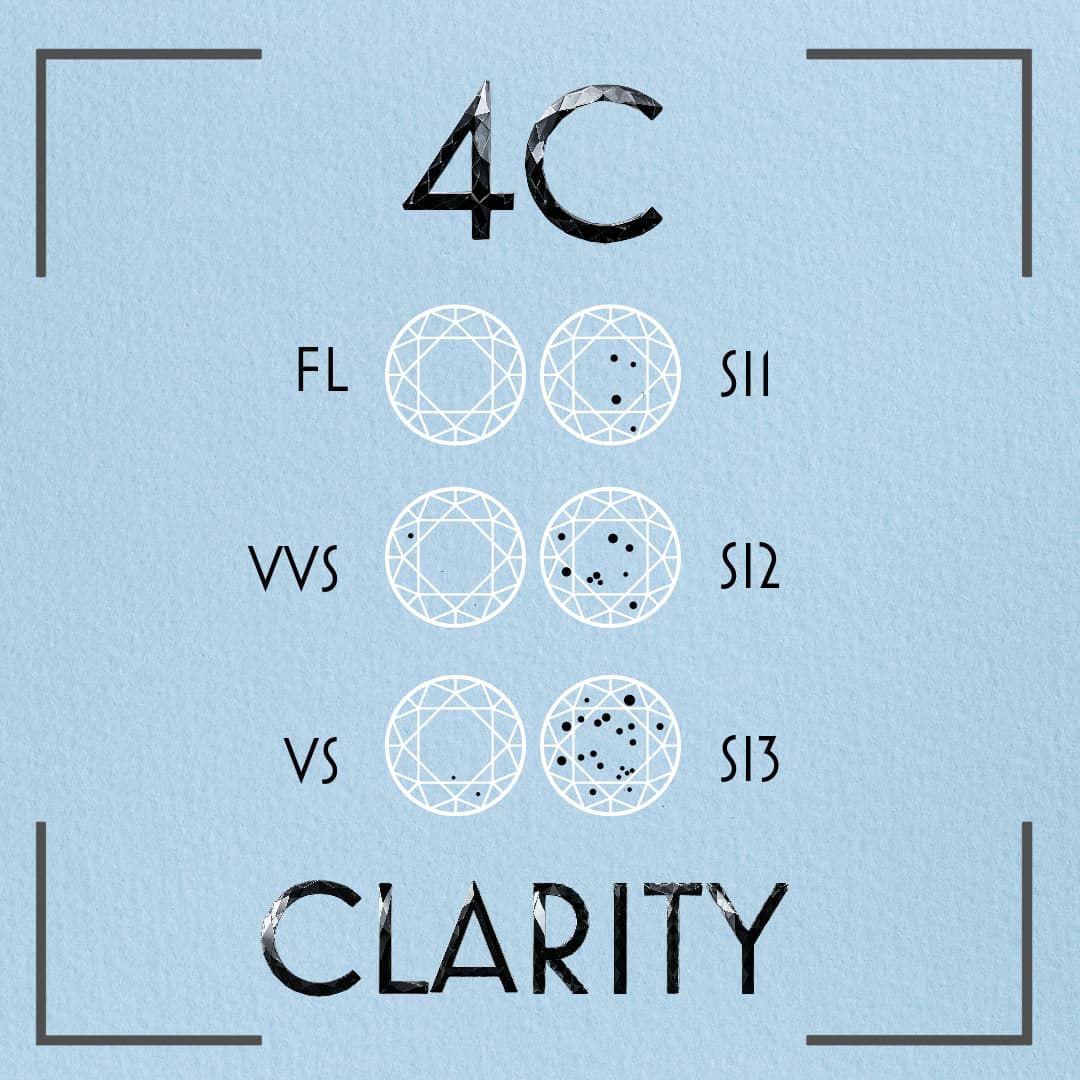
The clarity scale is used to measure the purity of a diamond. The general grading scale for clarity ranges from Flawless (FL) to Included (I).
When you purchase a diamond from a certified diamond dealer or a reputable store, it must always be accompanied by a certificate of guarantee from a recognized grading body, such as the IGI of Antwerp. This report is like your diamond's passport; it details the clarity characteristics, size, and type of your diamond.
Gemologists have created a 10-category grading scale for diamond clarity that is most commonly used in the wholesale diamond trade. So today, we'll simplify those 10 categories into 6 umbrella categories you should be aware of when choosing a diamond.
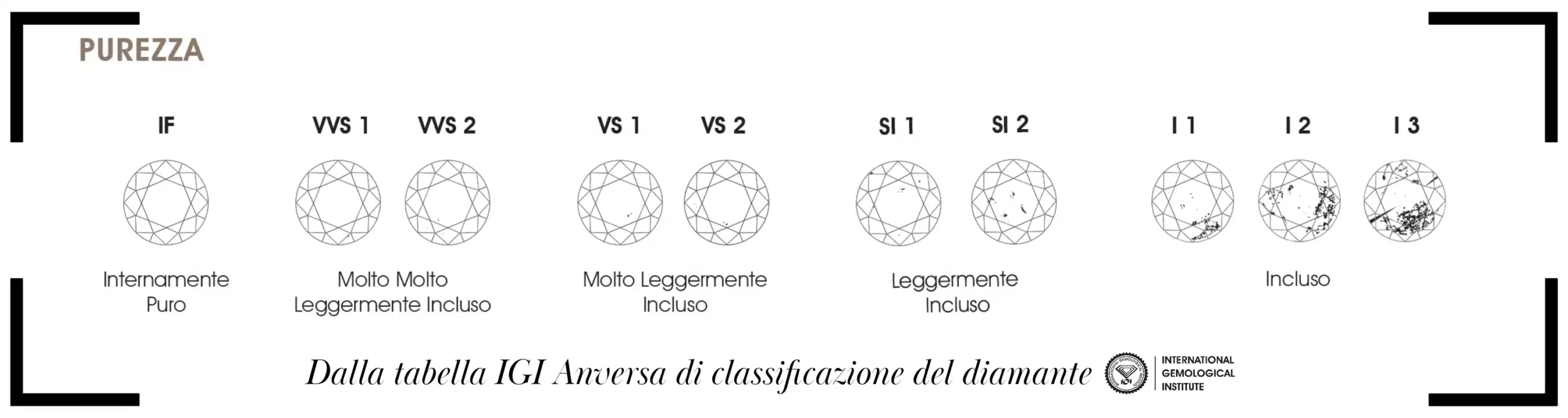
FL: Impeccable
What you see under a 10X magnifying glass: no external or internal inclusions.
IF: Internally flawless
What you see under a 10X magnifying glass: no visible internal or external inclusions, except for slight imperfections on the surface.
These two grades of diamond clarity are very rare and therefore the most expensive of all.
VVSI: Very Very Slightly Included
What you see under a 10X magnifying glass: very small inclusions that are extremely difficult to see.
VSI: Very Slightly Included
What you see under a 10X magnifying glass: more obvious inclusions that are still difficult to find.
These two diamond clarity grades are also quite rare, since less than 10% of natural diamonds are suitable for jewelry making in VVS or VS quality.
YES: Slightly Included
What you see with a 10X magnifying glass: it has inclusions but not always visible to the naked eye.
I: Included
What you see with a 10X magnifying glass: inclusions visible to the naked eye.
The clarity grade I is rarely used in diamond jewelry making, as its inclusions can make them more prone to breakage.
When you read about a clarity scale that depends entirely on the presence or absence of imperfections in a diamond, you might be curious to know what they look like. From long, fluffy white feathers to larger, wispy cloud-like structures, here are some of the common signs you'll see:
Understanding the beauty of a diamond comes with the realization that inclusion-free (FL) diamonds aren't always the most beautiful. In fact, inclusions make a diamond unique, allowing it to be beautiful in its own way.
It is important to know that the other three Cs, particularly the cut of the diamond , can also have a huge impact on its beauty and value.
When it comes to diamond clarity, the correlation between price and clarity grade can be quite unexpected.
When evaluating a diamond, it is not strictly necessary that it is at the top of the grading scale but how “clean” the diamond appears to the eye is more important.
A common misconception among diamond buyers is that a diamond must be flawless to be truly beautiful. If a consumer opts for VS clarity instead of VVS, they can expect to pay 10-12% less. By going down the clarity scale while keeping the diamond visually clean, you can save money and still buy a great diamond.
In fact, in many cases, a VS1 or VS2 diamond will be just as visually clean as an FL diamond, but will cost much less. A diamond's clarity depends on inclusions, and clarity grades that have inclusions not visible to the naked eye are preferable.
Rather than focusing on a particular grade on the scale, the best choice is to opt for the lowest purity grade that still appears clean to the eye.
Diamond clarity can be a complicated topic to understand, but sometimes knowing the basics can make all the difference. Now that you know a little more about the topic, the next time you're shopping for a diamond based on clarity, it's important to remember that diamond markings aren't just imperfections, but a representation of the stone's unique journey, originating billions of years ago deep within the Earth's core.
Moving on to the more technical side, it's also crucial to remember that most of the time, you get what you pay for. If the diamond you choose is at the top of the clarity grade, this will also be reflected in the price. This doesn't always mean your diamond is more beautiful than other diamonds.
After all, the most informed decision is the best one, especially when it comes to purchasing a natural diamond that will stay with you for the rest of your life and that you will pass down to your family.