“Gems have no voice but they speak.
The stones tell us about their origins, the depths of the Earth and the stories of humanity.”
Kate Harcourt
Natural diamonds carry a magic and history like no other stone on Earth.
Rare, timeless and exclusive, these jewels have made humans fall in love for millennia.
What makes the brilliance of a natural diamond unique?
And how do you know which piece of jewelry is perfect for you, in today's world filled with man-made diamonds?
The jewel you buy reflects who you are deep down, like all the choices you make: for this reason, a natural diamond, which is unique, is the one in tune with a person's true feelings.
How old are diamonds?
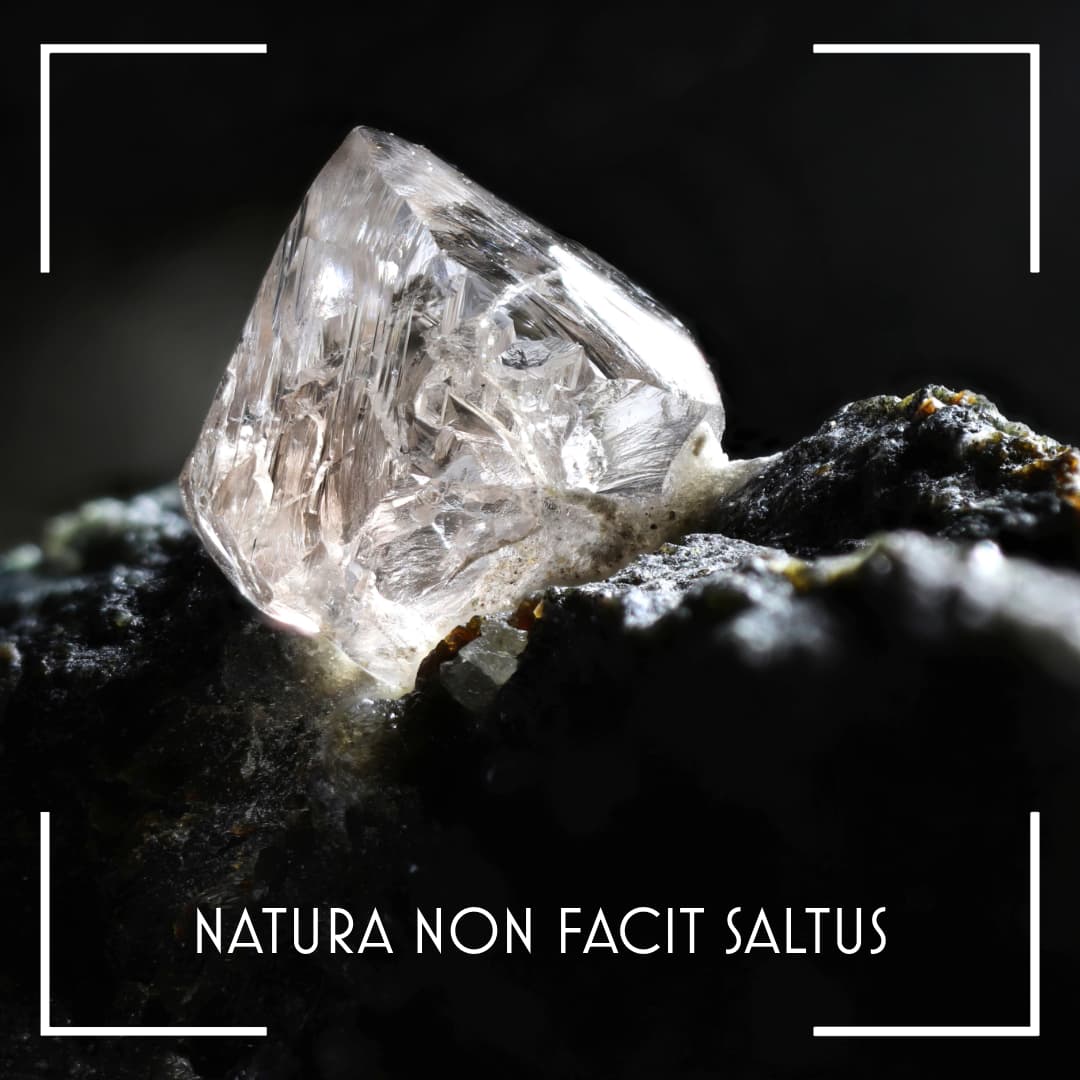
Most diamonds were formed between 1 and 3 billion years ago in the Earth's mantle and were transported to the surface by powerful volcanic eruptions, bursting forth with overwhelming force from the deepest depths: it is the story of a very long tale that narrates the uniqueness of a magic created slowly, in a patient wait that reveals an immortal beauty.
Diamonds are formed when carbon is subjected to enormous pressure and heat inside the Earth.
Kimberlite vents, the ancient underground volcanic formations that contain most diamonds, are very difficult to find, let alone those that are actually usable for mining.
In fact, most of the diamonds recovered today come from kimberlite pipes discovered decades ago.
Kimberlites are the rocks that carry diamonds from the depths of the Earth to the surface. They are very rare, and only a small portion of them contain high-quality diamonds.
This is why diamonds are so precious and represent the oldest things you will ever touch and own.
Given the uniqueness of their origin, no two diamonds in the world are identical : each one is unique, as is its formation and its adventurous journey, from the depths of the Earth to those of a promise of eternal love.
Are natural diamonds rare?
Yes, natural diamonds are a finite resource and are rare.
The number of newly mined diamonds peaked in 2005, when rough diamond production was about 30% higher than in 2022.
Over the past 140 years, nearly 7.000 kimberlite pipes (geological formations where primary diamond deposits are found) have been analyzed by geologists.
However, only about 60 of these have been deemed suitable for diamond mining.
This means that natural diamonds are a finite resource and their production is expected to decline over time.
Diamonds are also rare, which means they are not readily available.
This combination of fineness and rarity makes natural diamonds very valuable.
Responsible sourcing of natural diamonds and sustainability
The ethical sourcing of natural diamonds is a top priority for the global diamond industry.
The entire production chain that makes up the diamond industry is subject to the Kimberley Process , or in full Kimberley Process Certification Scheme (KPCS).
It is a joint initiative between governments, the diamond industry and civil society, mandated by the United Nations and the WTO, the World Trade Organization, with the specific aim of stemming the flow of conflict diamonds, that is, diamonds originating from war zones.
Today, 82 countries participate in the Kimberley Process, and more than 99.8% of the world's natural diamonds are certified conflict-free.
Fullcut Diamonds It only sources from producers adhering to the Kimberley Process to guarantee its customers certified diamonds from ethical and sustainable sources.
Environmental impact of natural diamonds
The diamond industry has taken many extraordinary steps toward sustainability and creating a positive environmental impact, from providing protected habitat for thousands of wildlife species in diamond fields to helping local communities around the world.
To optimize water and energy use, the diamond industry recycles 84% of the water it uses for its operations. Furthermore, a truth that few consumers know is that 99.99% of the waste produced to recover diamonds is rock : this debris is stored for future reuse when a mine closes.
Another little-known piece of news is that the plans for opening a mine already include a closure and environmental restoration plan.
The diamond industry has also been working for years to reduce energy consumption and CO2 emissions by using renewable energy to power its operations, such as wind turbines, hydropower, biogas, and solar.
The carbon footprint of a 1-carat natural diamond is less than that of a one-way flight from Genoa to Olbia, according to the 2021 Environmental Resources Management ( ERM ) report.
This footprint is set to continue to shrink thanks to the new energy-saving measures undertaken by diamond producers around the world.
Support for local communities
The entire diamond industry has a profound impact on the lives of millions of people.
Worldwide, the industry employs approximately 10 million people , and 80% of the value created by diamond sourcing remains in the communities where the stones are recovered in the form of taxes, investments in schools and hospitals, local purchasing, employment benefits, social programs, royalties, and dividends paid to their governments.
This translates to $6.9 billion directly absorbed by local communities.
The industry also employs more than 2 million people in India and directly contributes 7% of the country's GDP, while in Africa, more than 400 women-owned businesses have been funded thanks to natural diamonds.
Lab-grown diamonds: more affordable than natural diamonds, but…is cheaper better?
With lab-grown diamonds, there is no supply limit, and technological advances have only led to a reduction in production costs.
On the other hand, natural diamonds are a limited and rare resource, which makes them naturally precious and expensive.
The report by Bain and Co. , an international strategic consultancy, shows how over the last 30 years, natural diamonds have increased in value by an average of 3% each year.
On the other hand, the cost of lab-grown diamonds continues to fall: find out more in the recent article What Are Synthetic Diamonds Worth?
Why buy natural diamonds?
Natural diamonds possess a quality that no other gemstone possesses, they are truly precious.
These jewels of the Earth are limited, and the particular, explosive volcanic activity that created them, no longer existing, will create no more. The love that humans have always had for them, the brilliance they bring to the world, not only physical but also symbolic, will become increasingly rare over time, so it is with the love we give to every diamond created by the Earth that we carry on this legacy.
With every natural diamond we invest in, purchase, pass on, and love, we pass on a brilliance that is as rare and timeless as the Earth itself.
For these reasons, Fullcut Diamonds sells exclusively and high-quality natural diamonds., certified and of the best quality.
Natural is rare.
Rare is precious.