

What Is The Downside of Buying Lab-Grown Diamonds?
There are four fundamental differences between natural diamonds and lab-grown diamonds: time, environmental impact, value, and economic and social impact.
The time it takes for a diamond to form
Natural diamonds take millennia to form in the Earth, while lab-grown diamonds are created in a laboratory in just a few days.
This is also why the natural diamond is the stone of choice for declaring your love “forever” and not for five minutes.
The environmental impact of a diamond
For over 20 years, the natural diamond industry has been fully committed to restoring the natural environment of its supply areas and protecting local endangered species.
99% of the waste produced by natural diamond mining is rock.
However, to reproduce in the laboratory conditions similar to those that allow the formation of a diamond in nature – maximum pressure and heat – requires an abnormal consumption of water and electricity.
The value of a diamond
While natural diamonds are rare and a store of value, lab-grown diamonds have such a low purchase cost that they can guarantee the seller a 90% margin .
While the customer thinks he is making an ethical, green and economical purchase, in reality he has simply thrown his money away on a stone whose commercial value is equal to zero.
The economic and social impact of diamonds
The natural diamond industry today safely employs millions of workers on equal terms, reinvesting most of its profits locally into the creation of schools, universities, hospitals, and wildlife sanctuaries.
The lab-grown diamond industry is not seeing any such action.
What is the difference between lab-grown and natural diamonds?
A natural diamond is a rare, finite mineral created by the Earth, consisting of a crystalline form of pure carbon, the hardest substance in nature.
A synthetic, or lab-grown, diamond is a man-made product that mimics the physical characteristics and optical properties of a natural diamond, and can be produced in unlimited quantities within a few days.
When used alone, the term “diamond” always and exclusively refers to natural diamonds.
The words “natural,” “real,” “genuine,” and “precious” can only be used to describe natural diamonds sourced from the Earth.
Federal Trade Commission Jewelry Guidelines
What Are Lab Grown Diamonds
A synthetic or lab-grown diamond, also known as a lab-created diamond or man-made diamond, is a man-made stone that mimics the physical and optical properties of a natural diamond.
- Production: Unlike natural diamonds, synthetic ones can be produced in unlimited quantities, today even in just a few days.
- Technologies: are created through advanced technologies such as High Pressure High Temperature (HPHT) or Chemical Vapor Deposition (CVD).
- Production: Simulating the conditions under which natural diamonds form deep in the Earth's mantle requires a giga waste of water and energy contrary to the green philosophy that synthetic diamond marketing would have us believe.
From a commercial and marketing point of view, synthetic diamond is:
a commercial speculation : a product with a negligible cost resold at a massive premium, exploiting the customer's information asymmetry;
an artificial value : a stone whose price is supported solely by marketing campaigns and not by any intrinsic, rare or historical value.
A market bubble : a product sold (and perceived) as a real diamond. Since the price is bound to fall further as industrial production capacity increases, it is purely speculative and has no basis in fact.
a parasitic margin : it erodes the value of the luxury market by applying disproportionate markups to an industrial product that lacks uniqueness.
From an ecological and socio-economic point of view, this is where artificial diamonds show their worst side:
The Greenwashing Deception : The "ethical" or "eco-friendly" labels associated with synthetic diamonds constitute one of the most subtle forms of greenwashing, artfully crafted to appeal to the most environmentally conscious audiences. This marketing manipulates public perception, omitting the industrial reality behind the product's creation. The narrative loses all validity when compared to the actual environmental impact of the production sites.
Extreme resource consumption : The creation of synthetic diamonds requires constant and massive energy input to simulate the high pressure and temperature conditions necessary for their formation. Water consumption is equally high, as it is essential for cooling systems and industrial manufacturing processes. This requirement undermines any claim of environmental neutrality.
Supply chain opacity : Production is concentrated in Asia, India, and China, areas where regulations are often limited. There is a lack of verifiable reporting that illustrates working conditions or the long-term socioeconomic impacts in these regions. Choosing these products means supporting an opaque supply chain, lacking certified standards regarding worker well-being and effective environmental protection.
Why Fullcut Does Not Sell Lab-Grown Diamonds?
We refuse to sell synthetic diamonds because we respect diamonds and our customers.
Synthetic diamonds have no value and as members of the Antwerp Diamond Bourse and as dealers of natural diamonds for three generations, we know this very well.
Every day we are contacted by Asian traders offering to buy synthetic diamonds at increasingly low prices, almost outrageously low.
We could earn a 90% markup, but we preferred to maintain our dignity out of respect for our long history.
Precisely because synthetic diamonds are worthless, we have decided to combat this consumer deception in the only way possible: by giving them away.
We're giving them away to demonstrate that spending €1.500 to €3.000 on a 1-carat synthetic diamond ring is a mistake, given that the market value of these stones is, in effect, zero.
Because we believe in the uniqueness and authenticity of what the earth has given us, precious and ancient.
Because we know that natural is rare and rare is precious.
What is mass-produced in unlimited quantities is not and never will be rare and precious.
Because we oppose façade environmentalism, misinformation, and current trends.
We believe only in the value, quality, and transparency owed to the customers who have honored us with their trust for decades.
Are Lab Grown Diamonds certified?
Yes, even lab-grown diamonds must have a specific certificate attesting to their lab origin, mostly as a safeguard against natural diamonds, since the cost of the certificate , $15 per carat (with a $5 penalty if the stone is rejected), always exceeds the real commercial value of lab-grown diamonds , which, remember, is zero.
Among the institutions that certify synthetic diamonds are the IGI in Antwerp and the GIA in the United States.
As of October 1, 2025, the GIA has definitively abandoned the 4C standard for natural diamonds for the certification of synthetic diamonds, introducing specific descriptive terms for factory-made products , since 95% of lab-grown diamonds are of standardized quality.
This initiative alone already attests to the clear difference between the origin, rarity and value of natural diamonds compared to synthetic ones.
The GIA's new synthetic diamond grading system divides lab-grown stones (0,15 carats or more) into two categories: Premium or Standard.
Samples below the minimum requirements are not evaluated.
Premium Requirements : D color, VVS clarity or better, excellent cleanliness/symmetry, and “Excellent” cut (for round brilliants only).
Standard Requirements : Color from E to J, clarity VS, cleanliness/symmetry and cut “Very Good”.
The service includes a paper report and the mandatory “Laboratory-Grown” laser engraving on the belt.
Are Lab Grown Diamonds Worth Anything?
There is only one correct answer: ZERO.
If in 2019, the discount applied to the Rapaport price list on lab-grown diamonds was 84%, today in 2026 it is 99%.
This means that any price paid for a synthetic diamond is just a dealer markup and zero value to the customer.
While natural diamond prices have increased by an average of about 3% annually over the past 35 years, in its 2019 Global Diamond Industry Report, strategic consulting firm Bain & Co. found that over the past 50 years, the natural diamond market has grown threefold.
Between 2016 and 2022, the prices of lab-grown synthetic diamonds decreased significantly, from 80% of their original price in 2016 to 20-25% in 2022, reaching 18% in the first quarter of 2026.
Similarly, the price of synthetic rubies and sapphires is 10% of their natural equivalents.
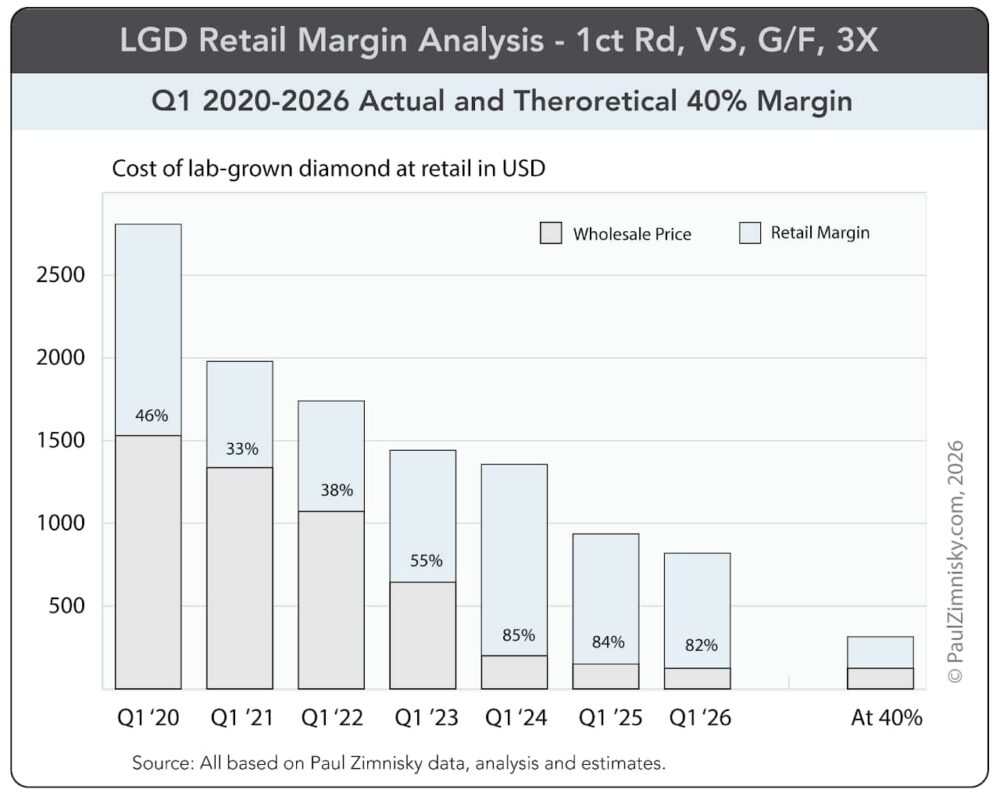
An example of the 2026 retail margin on 1-carat synthetic diamonds (82%) is in the table below from respected market analyst Paul Zimnisky:
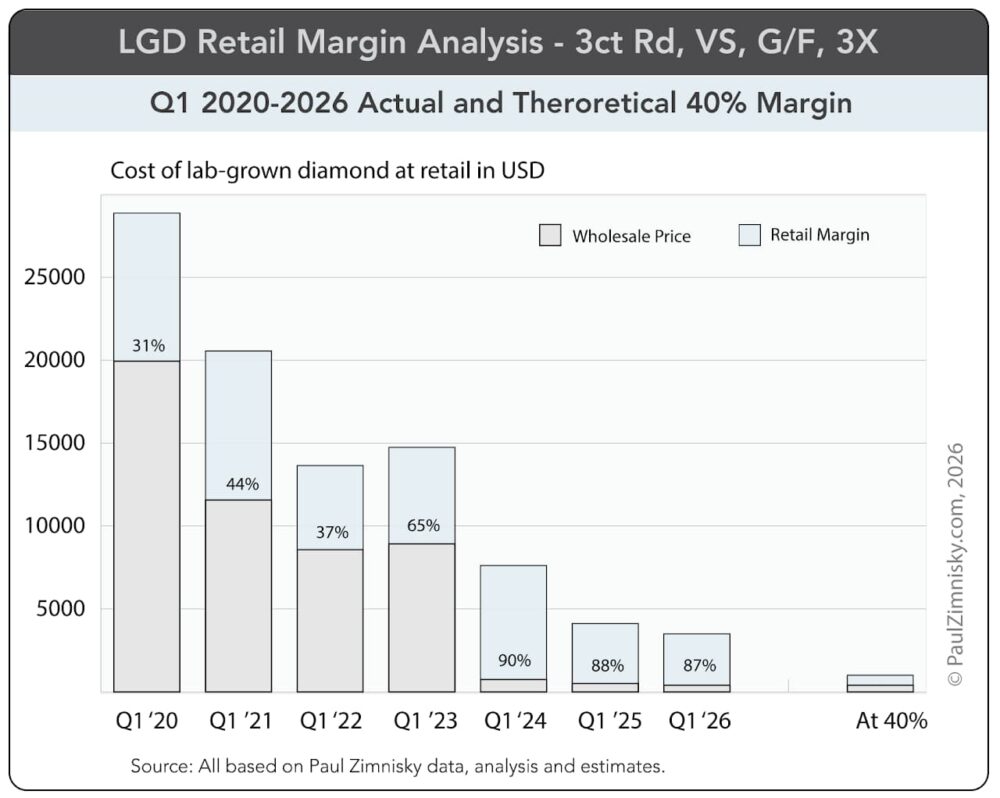
And again, in this other table the 87% margin on 3 carat lab-grown diamonds:
Are Lab-Grown Diamonds Real?
No. Lab-created synthetic diamonds are not identical to natural diamonds.
The origin is the main difference.
Synthetic diamonds are mass-produced in factories located mainly in China , India and Singapore, in industrial reactors.
Natural diamonds take billions of years to form and finally reach the finger of a beautiful lady as the perfect symbol of eternity.
The rapid artificial production process , which takes anywhere from a few hours to a few days, leaves distinctive markings within the stones, making them easy to distinguish from natural diamonds with the right equipment.
Are Lab Grown Diamonds Unique?
No, synthetic diamonds are not unique.
They are mass-produced in unlimited quantities and in standardized quality in 95% of cases.
Only natural diamonds are always unique , like a fingerprint or a snowflake, since Mother Nature created each diamond different from the other.
When you choose a natural diamond, you buy a unique piece, not one of many.
For this reason, several states have passed strict laws to protect buyers: synthetic stones can no longer be called “diamonds” nor be judged by the same parameters as natural diamonds.
To learn more, read the article Lab-Grown Diamonds: Russia joins Africa and France to Protect Consumers

What Are Ethical Diamonds?
Ethical diamonds are only natural ones, for environmental and socio-economic reasons.
The natural diamond industry employs 10 million people worldwide and reinvests in the mining areas, continually improving the environment and living conditions of the communities where it operates. For 20 years, it has been committed to recovering and marketing diamonds responsibly and with traceability.
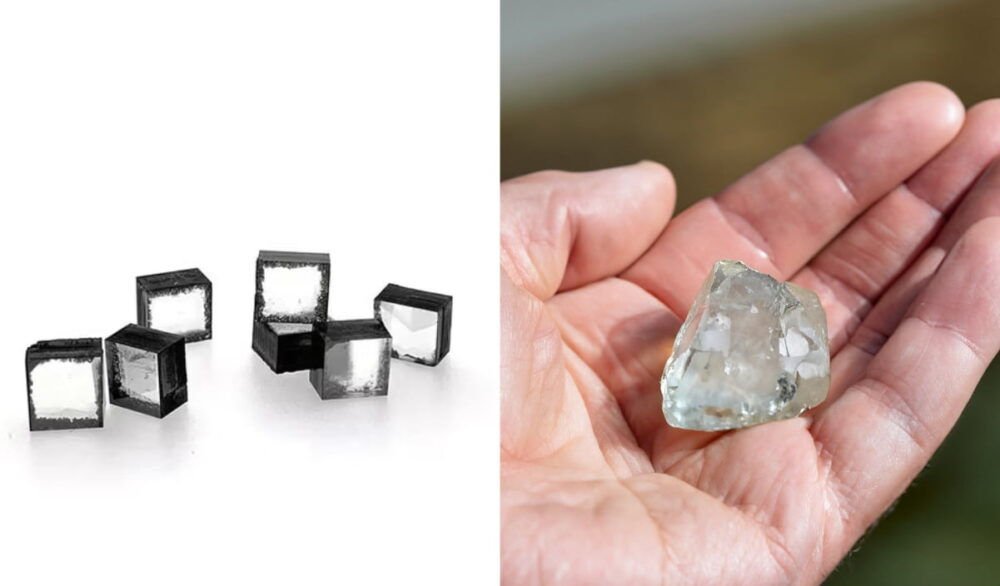
The wealth generated by those who create synthetic diamonds largely benefits only a small number of venture capitalists and investors, since lab-growns are a business only for those who sell them , certainly not for the consumer who buys them at an average markup of 80%, believing he is making an ethical choice.
The enormous water and energy consumption required to produce lab grown diamonds belies any claims of sustainability or ethical marketing.
Lab grown diamond companies are a new industry nestled in Asian countries, and their social impact is unknown. However, we know how energy-intensive the lab grown diamond production process is and howmisleading its marketing is for consumers.
The commitment of the natural diamond industry is concrete and measurable:
Protection and Ethics : thanks to the Kimberley Process and strict international regulations, for 20 years the industry has guaranteed a responsible and fully traceable supply chain.
Economic Impact : Generates $16 billion in annual socioeconomic benefits, with 80% reinvested in local communities, and allocates over $292 million to education and healthcare.
Employment and Wellbeing : Supports over 10 million jobs worldwide. Employees earn an average of 64% more than the national average wage and nearly five times the minimum wage in the country where the deposit is located, creating secure careers in regions where opportunities are scarce.
Workplace safety : Mining operations are extremely safe, with only one accident per 1.000.000 hours worked: a rate 15 times lower than the retail sector and 30 times lower than the transportation sector.
Crafts Sector : Represents 15% of global production and employs 1,5 million people; the industry actively collaborates with governments and NGOs to continuously improve working conditions.
Warranty Fullcut: all the diamonds proposed by Fullcut They are natural, sourced in full compliance with environmental sustainability and international ethical standards.
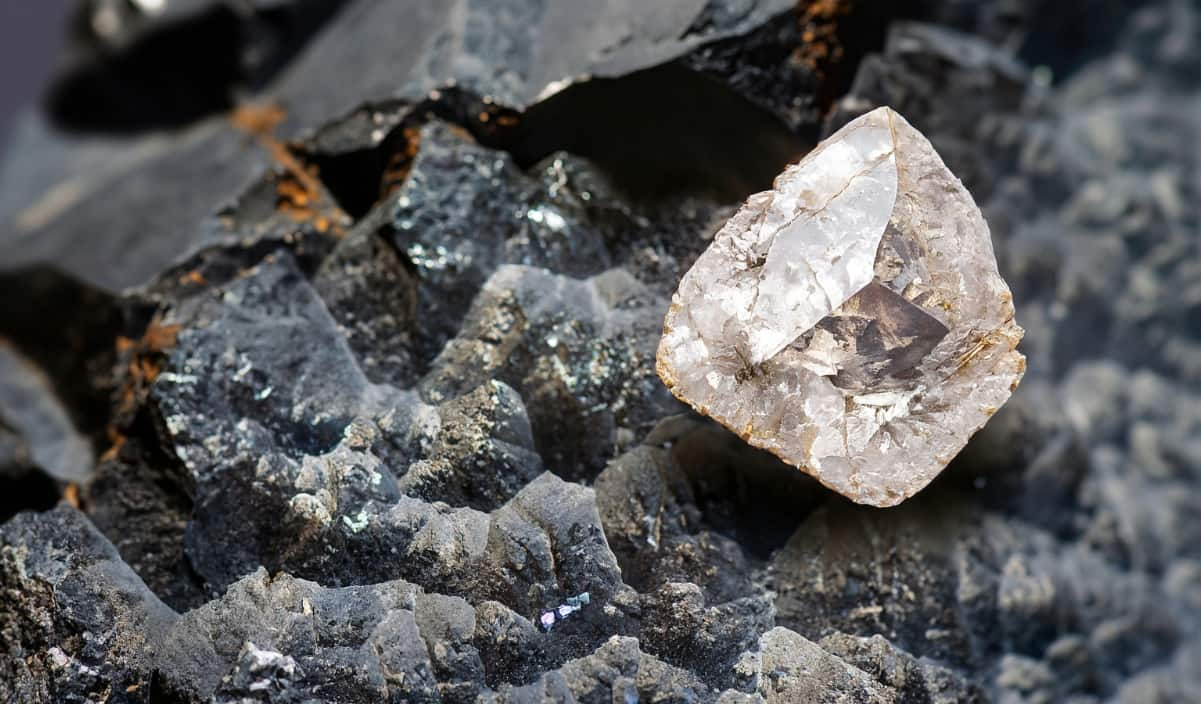
What Is the Downside of Lab Grown Diamonds?
To produce lab gown diamonds, a huge amount of electricity must be used to recreate the conditions in which diamonds form naturally in the Earth and generate temperatures of about 1.500 degrees Celsius and a pressure of over 680 tons per square inch.
The consumption of large quantities of water is necessary to cool the reactors in which lab grown diamonds are produced.
84% of the water used to mine natural diamonds is recycled. 99% of the waste produced from mining is rock, and no toxic chemical byproducts are produced.
About 60% of LGDs (lab-grown diamonds) are produced in China and India, countries that rely heavily on coal.
Coal is a fossil fuel that produces carbon emissions, which contribute to climate change.
The natural diamond industry is making great strides in reducing CO2 emissions to achieve carbon neutrality (zero emissions) by 2030, utilizing renewable energy sources such as wind and hydroelectric farms, as well as pioneering carbon capture technologies from kimberlite (the source of diamonds), which naturally absorbs and stores CO2.
Major natural diamond companies on average recycle 84% of the water used in mining and 99% of the waste produced is rock.
There are no toxic chemical byproducts , because once removed from the ground the diamonds are easily extracted from the host rock.
Are Lab-Grown Diamonds Considered Fake?
Lab-grown diamonds are man-made stones.
They are made of the same substance as natural diamonds and created by simulating the same formation conditions but are mass-produced within hours, with highly polluting procedures and standardized quality, with a real market value of zero.
For these reasons, Russia has also joined the Federal Trade Commission guidelines, mandating the use of only the term “synthetic” for laboratory diamonds, as well as indicating the weight of unmined stones in grams , rather than carats, and also prohibiting the use of the word “diamond” and the 4C characteristics , associated with natural diamonds, to describe man-made diamonds.