

The fascinating world of diamond colors and colored diamonds, explained simply.
To simplify what color is and how it affects other diamond characteristics, this article explains the basics to help you choose the perfect natural diamond for you.
Color actually refers to the lack of color in a diamond. In fact, the color grading of a gem-quality diamond is based on the absence of color.
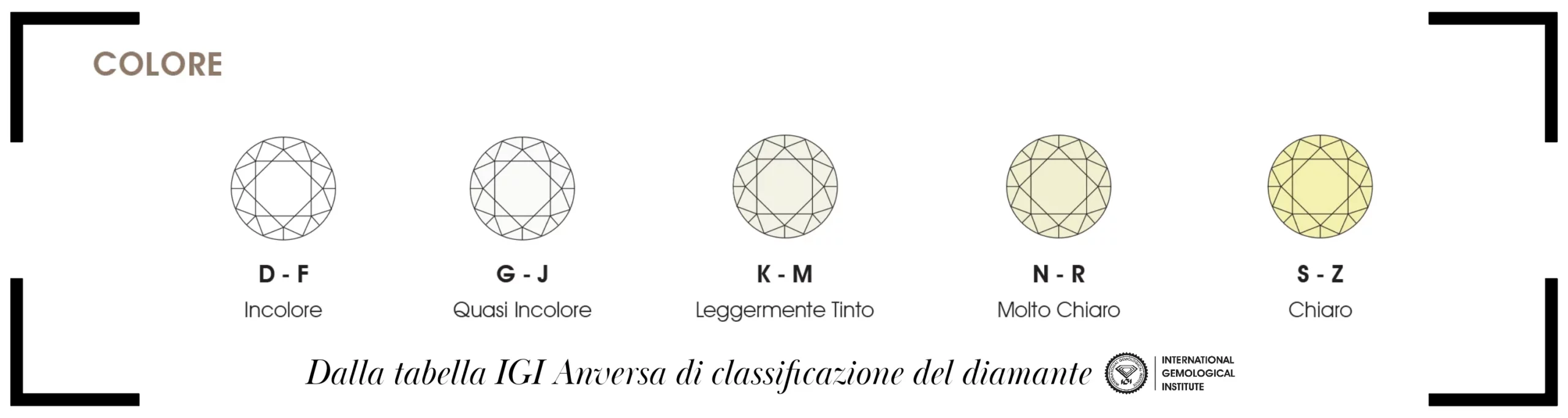
The diamond color grading system, which ranges from D to Z, measures the degree of colorlessness, with D being the highest grade and Z being a yellow or brown hue.
Therefore, as you proceed from D to Z on the scale, the value of the color and the diamond itself decreases.
Natural colored diamonds, outside of this standard color range that defines diamonds that have no color, are called diamonds fancy or fantasy.
Before the Gemological Institute of America (GIA) introduced diamond grading in the 50s, there was no standard grading terminology to describe a diamond's color, and thus its clarity.
Letter designations A, AA, AAA and numbers were not uncommon before then.
To establish a grading standard, the GIA decided to assign the highest color grade to the letter D and to descend through the letters of the alphabet in step with the increase in yellow color saturation up to the letter Z.
When a diamond's color saturation goes beyond Z color, it can be considered a fantasy color (fancy).
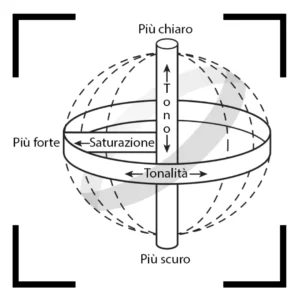
The color of a diamond is a combination of hue, saturation, and tone.
Simply put, it represents its color, the amount present and its brightness.
The Commission Internationale de l'Eclairage (CIE) discovered in 1931 that each of these components can be measured.
Hue represents the dominant color of the diamond and can be influenced by the presence of a “modifier” or a “tint,” which are additional hues within the stone.
A diamond can have a single color, such as pink, or have a secondary color: if a pink diamond, for example, has a purple hue, its color will be classified as “purple pink.”
Colored diamonds are called diamonds fancy.
 Saturation
 refers to the strength and intensity of the diamond's primary color hue.
The saturation of diamonds with a lighter tone is indicated with terms ranging from “light” to “intense” to “vivid”.
For darker diamonds, the description ranges from “dark” to “deep.”
Tone refers to how light or dark the diamond appears. This is determined by how much brown, black, gray, or white is present in the stone.
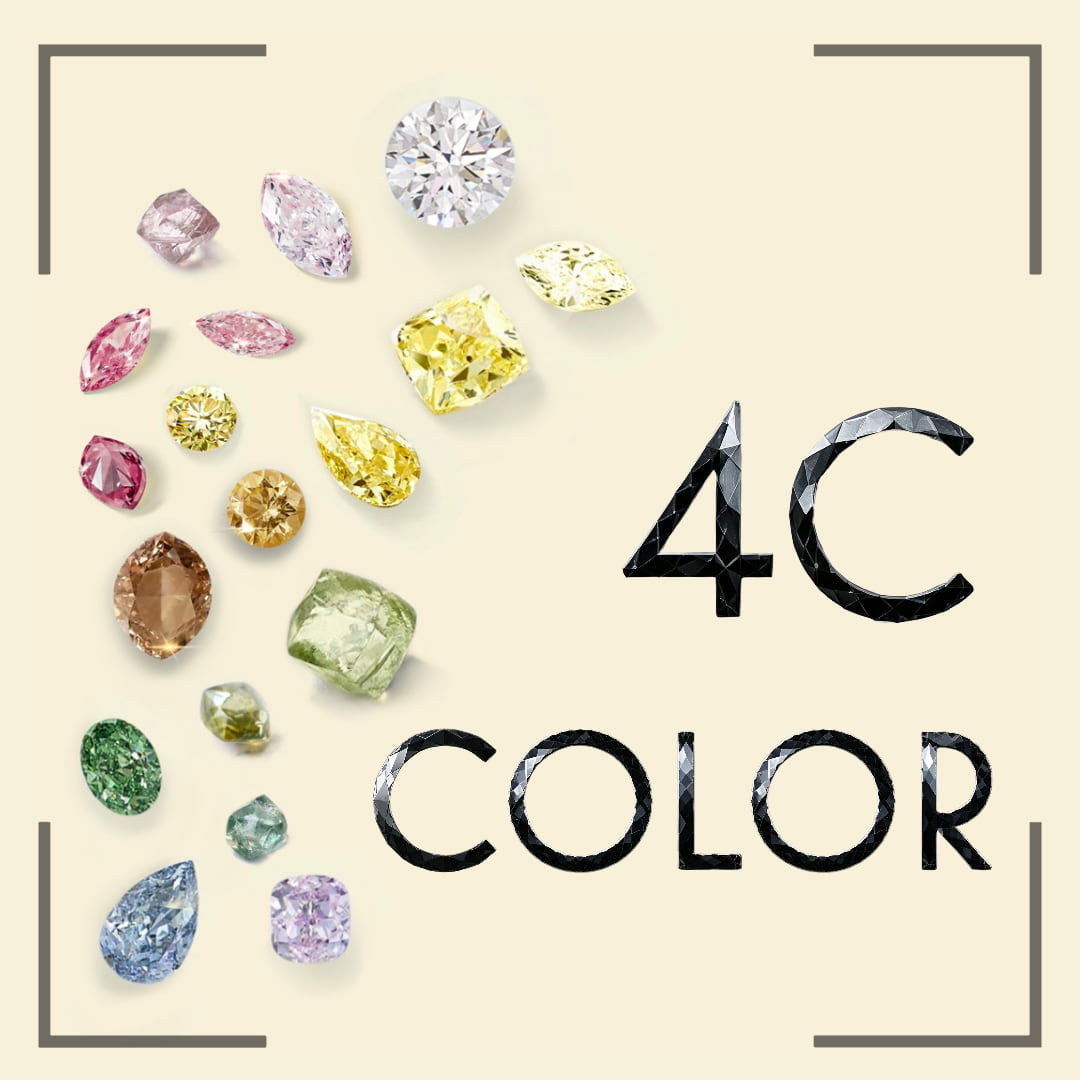
 Diamonds come in all colors, from three maximum degrees of colorlessness (designated with the letters D, E or F) up to the different saturations of yellow (from K to Z). Outside this scale, colored diamonds fancy They come in a wide range of colors, tones, and saturations: yellow, green, blue, red, pink, brown, orange, purple, gray, black, and more.
Some are rarer than others but colored diamonds are certainly rarer than their colorless counterparts.
The various geological processes that favored the growth of diamonds at depths of 150-600 kilometers in the Earth's mantle, billions of years ago, are responsible for these rare colors, which cover the entire spectrum of the rainbow.
Only the near-perfect combination of these elements during the diamond's journey to the Earth's surface was able to create the rarest fantasy colors.
With all this propulsive activity taking place deep in the Earth's mantle, it's no surprise that truly colorless diamonds are so rare.
The most common color in gem-quality diamonds is yellow , usually caused by the element nitrogen incorporated into a diamond's carbon atoms.
Higher concentrations of nitrogen produce greater yellow color saturation and a deep, vivid appearance.
 Yellow diamond
Color variations : canary yellow, brownish yellow, greenish yellow, orange-yellow.
Color Formation : Yellow diamonds owe their color to the nitrogen present within the stone's crystalline structure. The nitrogen atoms are replaced by carbon atoms, which react with light, giving the diamond its yellow color.
Yellow Diamond Meaning : Yellow diamonds are a symbol of joy, happiness, and prosperity. They are associated with self-esteem, clarity of thought, and encourage creativity.
It is also common for other shades of brown, green, and orange to have yellow as an altering element.
Colorless or white diamonds contain little or no nitrogen, which can account for up to 1% of a diamond's mass.
Because diamonds with incorporated nitrogen absorb blue light , the result is that their appearance takes on various shades of yellow, from the palest to the brightest.
Blue, purple, and gray diamonds incorporate the element boron into their atomic structure and are highly impressive.
Fancy blue diamonds are highly prized, and many have been appraised or recently sold for millions of dollars per carat.
 Blue diamond
Color variations : blue, grayish blue, greenish blue, turquoise, aquamarine.
Color formation : The color of blue diamonds is caused by the presence of boron atoms: the higher the concentration, the greater the intensity of blue.
Only one in 200.000 diamonds is blue, and even fewer are deep blue.
What does the blue diamond mean?
Blue diamonds are associated with the most sophisticated elegance and are the symbol of calm, serenity, truth and determination.
 Diamond violet
Color variations : violet, pinkish purple, grayish purple.
Color Formation : Purple diamond color is caused by internal crystal formations and sometimes the presence of hydrogen.
Purple Diamond Meaning : With a regal color that represents nobility and luxury, the purple diamond is believed to bring universal connections, guidance, inspiration, wisdom, inner strength, and longevity in relationships.
Green diamonds get their natural color from the distortion of their atoms when they were exposed to radioactivity in nature, millions of years ago.
This does not mean that green diamonds are radioactive!
 Green diamonds
Color variations : grayish green, yellowish green, bluish green, brownish green.
Color Formation : The green color is due to millions of years of exposure to natural radiation. Sometimes, the green hue can be caused by the presence of hydrogen within the stone.
Meaning : Considered the emblem of the essence of life, the green diamond promotes youth, vitality, and balance. Just as green is the color of hope, in diamonds it is also associated with truth and loving, healthy relationships.
Red, pink, and brown diamonds are the result of plastic distortion of their atomic structure caused by the immense pressures and temperatures during their formation deep within the Earth.
 Pink diamond
Color variations : pink, purplish pink, champagne pink, brownish pink.
Color Formation : The exact reason for the color of pink diamonds remains a mystery, even to scientists. Geologists have hypothesized that the cause of pink diamond formation may be traced back to a deformation in the atomic structure in the Kimberley region of Australia, which impacted the minerals.
Meaning : Pink diamonds are known as a symbol of creativity, femininity, love and romance.
Light passing through these distorted crystals is filtered, releasing different shades of red, pink, and brown.
Pink diamonds Fancy Pink are among the most desirable of all diamonds.
They are often accompanied by a hue of purple, brown, or orange, creating an impressive array of variations.
Il Pink star is the biggest Fancy Vivid Pink of 59,60 carats.
The 132,50-carat rough was discovered in southern Africa in 1999.
It took almost 2 years to plan its oval shape and polish it.
In 2017 it was sold at auction for $ 71,2 million.
 Orange diamonds
Color variations : reddish orange, yellowish orange, brownish orange.
Color formation : The orange color is due to a combination of structural deformations and the presence of nitrogen.
Meaning : Believed to inspire boldness, creativity, and productivity, the orange diamond is exotic and evocative of distant lands.
 Brown diamond
Color variations : champagne, light brown, cognac, chocolate, hazelnut, honey, clove.
Color Formation : The color of a brown diamond is caused by internal lines of parallel crystals. The hue can be altered by structural distortions in the diamond's lattice, which affect its light absorption.
Meaning : Often associated with the Earth and nature, the brown diamond symbolizes harmony and tradition. It expresses a refined and discreet elegance, and in the symbolism that has always been attributed to it, it represents harmony in relationships.
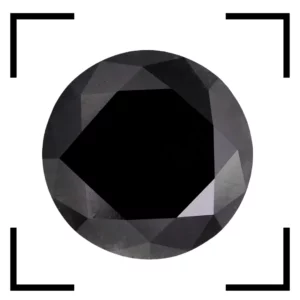
Color variations : There are no real color variations but the white or gray inclusions make the black diamond particularly unique.
Color Formation : Black diamonds get their color from numerous graphite inclusions. Some black diamonds contain traces of nitrogen and hydrogen, which can affect their color. Some geologists believe that black diamonds fell to Earth in a meteor shower.
Black diamond meaning : Since ancient times, the black diamond has been considered a symbol of strength and inner power, with the belief that wearing one would enable one to overcome any obstacle. It represents trust in a relationship and the strength to overcome any adversity within a couple.
The red diamond, Fancy Red, is the rarest.
The red diamond is so rare that only a very few have been discovered that can truly be classified as red.
Its striking appearance and extreme rarity make the red diamond the most prized of all.
Red diamonds are also the most expensive. A small red diamond can cost millions of dollars.
But even in other colors, there are diamonds that, although weighing less than a carat , are very rare and expensive: they are pink, blue, green and orange.
 Red diamond
Color variations : brownish red, pinkish red, purplish red.
Color Formation : Red diamonds get their color from a process of plastic deformation. This occurs when a distortion occurs in the diamond's atomic lattice.
Red diamond meaning : It symbolizes passion and ardent love that lasts forever. With its vibrant color, the red diamond has been considered a lucky charm since ancient times, channeling power, energy, and self-awareness.
Not exactly.
Some inclusions may have their own color, but these included crystals have no effect on the true color of the diamonds that host them.
The ideal color of a diamond is the one you choose in combination with the clarity, cut and carat, the other 3 Cs.
Within the D to Z diamond range, D-color diamonds are the rarest and most valuable . Among fancy-colored diamonds, red is considered the rarest, followed by blue, violet, pink, and so on.
 Choosing a diamond color depends on several factors, including your budget, personal taste, and your intended use of the diamond.
If you are looking for a diamond for an engagement ring or to celebrate an important event, such as an anniversary or a baptism , D, E and F color diamonds are the best choice.
Next in line is the most sought-after color, G , which represents excellent value for money if you are looking for a diamond for yourself, to wear every day: it can be an excellent option for your jewelry, also because the color difference is imperceptible to the naked eye.
The G color diamond is also the first choice of many godmothers and godfathers as the first Baptism gift to the child, when they choose to give a gift that grows with the child until he or she is eighteen, through the service of diamond upgrade made available by Fullcut Diamonds.
It is important to remember that there is no ideal diamond color.
The perfect color for you is the one you like most and that suits your personal style.
 How much does color affect the value of a diamond?
The impact of color grade on a diamond's value depends on its rarity.
For example, the price difference between two 1 carat D and E color diamonds with IF (Internally Perfect) clarity can be 25%.
For 1 carat diamonds, always of D and E color but of SI2 clarity, the difference is approximately 5%, since in this case purity is the predominant factor in determining the price, rather than color.
D-color diamonds are the rarest and most valuable, followed by E- and F-color diamonds.
 As the diamond's color moves from the letter S to the letter Z, the stone takes on increasingly intense shades of yellow or brown, significantly decreasing its value. In these cases, these diamonds are not suitable for engagement rings or jewelry marking important events such as a baptism, a proposal, or a wedding anniversary, where the symbolism of the diamond's clarity is an integral part of the bond you wish to celebrate.
 It is important to remember that color is not the only factor that determines the value of a diamond.
The other three important factors are clarity, cut, and carat.
When purchasing a diamond, it is important to consider all of these factors to ensure you get the best value possible.
Diamond color is graded by looking at the stone face down because cut and fluorescence can often affect the readability of its color grade.
A poorly cut diamond with a flat crown may appear whiter than a diamond with excellent proportions and a fuller crown, even though both have the exact same color.
Fluorescence can also make a yellowish diamond appear whiter, in the presence of UV light , when viewed face up.
Placing the diamond face down and viewing it through the pavilion allows for a more accurate evaluation, and is standard practice in the diamond industry.
 Is the color of a diamond noticeable when it is set in jewelry?
The color of a diamond has little impact on its appearance once it is set in a jewel.
In fact, it would take a true professional to distinguish a D color diamond from an F color diamond in a solitaire, for example.
But this professional would have to remove the stone from the ring to know its true color grade.
This is because the reflections of the metal in which the stone is mounted interfere with a clear reading of the diamond's true color.
Therefore, when purchasing a diamond jewel, you should always ask for the center stone or stones to be certified by a recognized international gemological institute, such as the IGI of Antwerp, the GIA, or the HRD (the most recognized diamond certification institutes in the world), to ensure you know exactly and impartially what color it is, along with its other characteristics.
Only in this way can you be completely certain of the quality of the diamond you are about to purchase.
In these cases, the guarantee of the jewel issued by the seller – not being issued by an impartial third party like the institutions mentioned above – is not reliable and you may only discover later and too late that you have purchased stones of lower quality than declared , if not even poor quality or, worse, that they are not even natural diamonds.
From this precaution you can exclude jewels with pavé diamonds (which are the many, very small stones next to each other that decorate the jewels), since the unit size of each diamond is so minute that it excludes the need for certification.
For these types of pavé work, it is important to know whether they are natural diamonds , their total carat weight and their average colour and clarity , which you can find from the guarantee issued by the jeweller.
Typically, more colorless diamonds are mounted in white or yellow gold or platinum to make them stand out as much as possible.
Conversely, warmer, yellowish diamonds should not be set in white metals unless the contrast is absolutely desired.
The most affordable colored diamonds are those that are more easily found in nature or those with a lower saturation.
Fancy diamonds are classified according to the strength of their color, as follows:
 Colors Fancy Intense and Fancy Vivid costs more than the others.
For example, a pink diamond Fancy Light Pink will be valued much less than a Fancy Vivid Pink, which has a strong saturation and is therefore rarer.
And a diamond Fancy Brown (maroon), will be valued much less than both.
The most common colored diamonds are in fact yellow and brown which, consequently, are generally less expensive than other colors.
In conclusion, we can say that there is a perfect diamond for every person.
Knowing the basics of color can help you make an informed purchase, whether you're buying a blister diamond or diamond jewelry.